
Meridian Directory Collections by Year
Meridian does not have one complete, city-only run on a single shelf. The strongest directory trail is filed with Boise and Ada County regional material. The Idaho State Historical Society inventory begins its Boise regional list in 1906, while the FamilySearch catalog for the R. L. Polk & Co. Boise City/Ada County directory begins in 1902. University of Idaho Special Collections tells researchers looking for Meridian to “See Boise.” That catalog choice matters because a city-only query can hide the right volume.
| Directory or collection | Verified span | Keeper | How to use it |
|---|---|---|---|
| Boise regional directories with Meridian coverage | 1906–1992, listed runs with gaps | Idaho State Historical Society | Confirm the volume and Meridian pages before treating coverage as complete. |
| Boise City/Ada County directories, R. L. Polk | 1902–1990 catalog span with gaps | FamilySearch | Film and digital access varies by year and account. |
| Boise telephone and business directories | Telephone 1945–2004; business 1934–1983, both with gaps | University of Idaho | Request Boise-region volumes because Meridian is cross-referenced there. |
| Meridian local newspapers | 1909–1999 across four principal titles | University of Idaho microfilm and Library of Congress | Use names, notices, ads, and exact dates to fill directory gaps. |
| Meridian History Center collections | Collection-specific; digital work began 2022 | Meridian Library District | Browse named albums and community collections online, then ask staff about undigitized items. |
Years in a catalog are shelf evidence, not proof that every Meridian household appears. Regional boundaries, missing volumes, unlisted phones, and publication gaps all affect results. Record the title, year, publisher, page, and repository with each find. Those details make it possible to return to the same city directory entry or request a clearer copy later.
The Idaho State Historical Society inventory lists many distinct runs rather than a smooth annual sequence: 1906–07, 1908, 1909–10, 1911–13, 1918–19, and selected later years through 1992. FamilySearch supplies another route, with early catalog examples tied to film or digital group numbers. Access can differ even between nearby years. One item may open online, another may require a FamilySearch account or center, and a third may be a catalog-only lead. Build a year checklist before visiting a repository so gaps are clear.
Why Meridian Directories Say Boise
The University of Idaho inventory uses a small but important cross-reference: Meridian says “See Boise.” Idaho State Historical Society listings likewise describe Boise regional volumes that include nearby Ada County communities. A search limited to a Meridian title can therefore miss useful pages. Search the University of Idaho directory inventory under Boise, then ask whether the volume contains a Meridian section, suburban listing, telephone exchange, or business entry.
This is a catalog quirk, not proof that every Boise volume covers Meridian. Check each book. Note the geographic wording on its title page and scan the table of contents, locality index, and abbreviation pages before searching names. FamilySearch also supports place, title, author, surname, and film or DGS searches, making “Boise City/Ada County” a better starting phrase than Meridian alone.
State and territorial business books can widen the hunt. University holdings list an Idaho Territory business directory from 1866, regional gazetteers from the late nineteenth century, and several Idaho state directories from the early twentieth century. These are possible sources for merchants, institutions, and civic names, not substitutes for a Meridian household directory. Search the person or firm, confirm the locality printed beside the entry, and avoid assigning a Boise or statewide listing to Meridian without that place evidence.
Meridian History Center People Collections
The Meridian History Center browse portal adds faces, clubs, schools, and local events that a city directory may reduce to one line. Its named groups include Dairy Days, Girl Graduate Album, Mayes Gray Collection, MLD History, Meridian Occident Club, Meridian Police Department from 1903 to the present, Pine Street/Meridian Elementary, and Willett Family Album. Search across more than one group because a classmate, relative, or civic participant may appear in several contexts.
The former Meridian Historical Society collection moved to Meridian Library District in 2021. Digitization began in 2022 with grant support, and the Library identified the collection page as updated in 2024. Online results represent only what has been processed. For shelf help, the History Center at 33 E Broadway lists weekday hours from 10:00 a.m. to 4:00 p.m. and phone 208-888-4451. The Library genealogy page also routes researchers to state and national resources.
A collection title should shape the next search. Girl Graduate Album and Pine Street/Meridian Elementary support school links. Occident Club and Dairy Days document civic and social participation. The Willett Family Album and Mayes Gray Collection may preserve family context, while the police and MLD history groups follow institutions over time. Item captions can supply variant names, approximate dates, and event terms to test in the Meridian Times. Ask Library staff whether an online thumbnail has a fuller description or related physical folder.
The successful manifest capture shows the History Center’s collection browse screen. Open the live collection list before relying on the image.
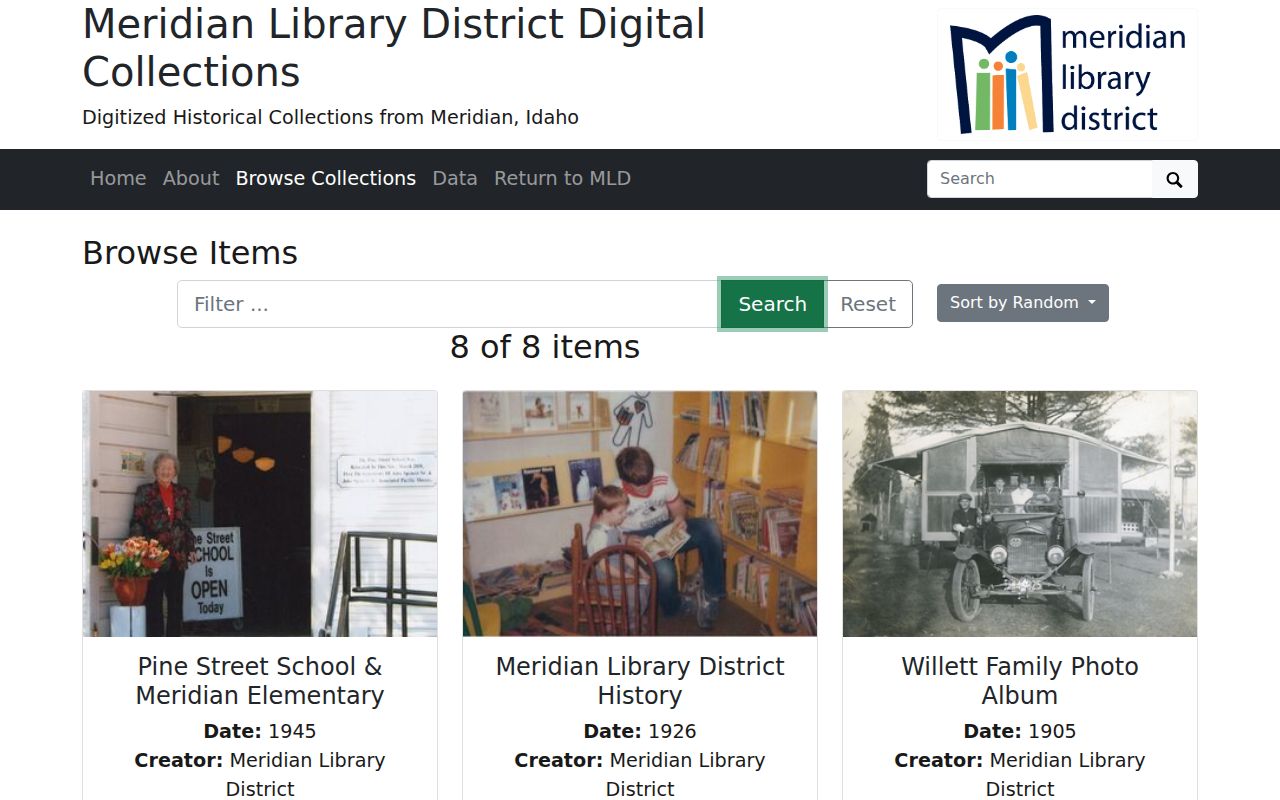
Use the collection names visible there as search paths, then preserve the item title and collection label with any downloaded citation.
Reading a Meridian Directory Entry
A Meridian city directory entry is a dated clue, not a full biography. Copy the line exactly before expanding initials or abbreviations. The expected fields in the Boise/Ada catalog runs include a surname and given name, spouse or household relation, occupation, business or employer, street and house number, and a phone number in later editions. Widow, boarding, institutional, and cross-reference marks can change the meaning. No complete Meridian page image was available during research, so these fields should be checked against the key printed in the actual volume rather than assigned a universal symbol.
| Name line | Surname, given name, initials, and sometimes spouse or household relation. |
|---|---|
| Work line | Occupation and, in some volumes, a business or employer. |
| Address line | House number, street, unit when used, and residence or boarding notation. |
| Later fields | Telephone number and cross-references that vary by year. |
| Status marks | Widow, deceased, institutional, or ownership symbols, interpreted through that volume’s key. |
- Criss-cross directory
- A reverse section arranged by street or address instead of by surname. A standalone Meridian run has not been verified, so ask the holding library.
- Householder index
- A name or address list centered on the person identified as the main household entry.
- Abbreviation key
- The volume-specific legend that explains shortened occupations, residence marks, and status notes. Save it with the entry.
Compare the same name across nearby years. A changed initial, spouse, job, or street format can distinguish two people with similar names. If the name disappears, do not assume death. The household may have moved, gone unlisted, changed its telephone status, or fallen outside that edition’s coverage.
Copy context from the lines above and below. They can reveal a business heading, institutional section, or alphabetical break that changes how the entry reads. Photograph the title page and abbreviation key when repository rules permit. If a spouse appears only in parentheses, do not turn that mark into a separate residence without another source. Likewise, an occupation or employer is evidence for that edition’s publication cycle, not proof of continuous work. Clear transcription preserves what the volume says and separates it from later interpretation.
Meridian Newspapers Fill Directory Gaps
Newspapers provide the dated notices and social details that directory rows omit. University of Idaho microfilm lists the Meridian Times from March 7, 1909 through January 30, 1958; Meridian News-Times from February 6, 1958 through September 26, 1968; Valley News-Times through October 1976; and Valley News into October 1999. Issue completeness can vary. The Library of Congress offers 661 Meridian Times issues from 1909 through 1938.
Search an exact name, address, business, or date near a directory appearance. Legal notices may explain an estate or property change. Advertisements can identify a shop tied to an occupation line. Club news and obituaries can connect relatives. Before the newspaper run, Meridian’s “Before the Times” archive transcribes local material from 1883 through 1909. Cite the title and issue date because newspaper names changed several times.
The sequence itself is useful. “Before the Times” reaches the years before the Meridian Times began. Meridian Times then leads into Meridian News-Times, Valley News-Times, and Valley News. Boise West and Treasure Valley Times add shorter later runs in the University inventory. Search the title active for the target date instead of assuming one paper name covered the whole century. When optical text search misses a surname, browse the issue around a known event and try initials, spouse names, street variants, and business names.
Local notices can resolve why a directory line changed. A marriage item may explain a surname, an estate notice may identify heirs, and a store advertisement may connect an abbreviated job to a full business name. Social columns can confirm that two people with similar names belonged to different families. Treat each item as a dated report and retain the newspaper title, issue date, page, and column. Scattered microfilm coverage means an absent notice has little weight unless the relevant issues are known to be complete.
Accessing Meridian Directory Archives
Use the online catalog first, then move to staff and shelf access. The FamilySearch Boise City/Ada County catalog provides year and film or DGS clues, but image access differs by item. A Meridian FamilySearch Center can offer trained help and access technology; confirm its current hours and local film access. University of Idaho Special Collections is the fallback for Boise-referenced telephone and business directories and Meridian newspaper microfilm.
Idaho State Historical Society adds searchable biographical, reconstructed census, naturalization, military, pension, and other indexes. Its Ada reconstructed census material covers 1885–1894. When catalogs fail, Archives staff accept research questions. Each request includes 30 minutes of complimentary reference time; further research may cost $25 per half hour for up to two additional hours. Onsite rules and copy charges apply, so ask for a quote before requesting many pages.
A focused request works best. Give the full name and variants, the likely Meridian or Ada County connection, an estimated year span, and the exact directory or index already checked. Include a spouse, parent, occupation, or street when known. The State Archives warns that names can be misspelled and that not all collections are cataloged. No online match is therefore not proof that the record is absent. Staff can point to an uncataloged manuscript group, paper index, reference series, or newspaper reel.
Meridian Library’s public-record request form is a separate access route for records held by the Library. It allows a requester to ask to examine material or receive copies, with email or printed pickup options listed. The form requires contact and service-area information and repeats Idaho’s restriction on creating mailing or telephone lists from public records. It is not a promise that every historical item is a public record or ready to scan. Describe the collection, person, date range, and intended item clearly so staff can route the question.
| FamilySearch catalog | Search place, keywords, title, author, subjects, surnames, film/DGS, and online availability. |
|---|---|
| History Center | Browse named collections online or contact Meridian Library staff about items not yet digitized. |
| State Archives | Search catalogs and indexes, visit the research room, or send a focused reference request. |
| University of Idaho | Request Boise-region directories and the relevant Meridian newspaper reel. |
Mail, online, and in-person access each solve a different problem. A catalog can identify the likely volume before travel. A concise email lets an archivist check a shelf note or unindexed folder. An onsite visit makes it easier to compare several years, inspect abbreviation pages, and review microfilm around a known date. If reproduction is limited, transcribe the entry and its neighboring headings, then record the repository and call number. Do not assume that a digital image can be copied or redistributed merely because it is visible. The State Historical Society specifically warns that personal-research and reproduction rules may apply.
Finding Meridian Classmates Across Collections
A past classmate may not be found through one city directory search. Start with the Girl Graduate Album or Pine Street/Meridian Elementary collection, then compare the name with the nearest regional directory year. A newspaper school item can confirm an event or group. The Meridian Cemetery plot search may provide an independent name, date, and section clue for a later life record.
Keep each source’s role clear. An album identifies a school or community connection. A directory places a listed person or household at a dated address. A newspaper reports an event, while a cemetery entry identifies a burial record. Agreement among several sources is stronger than a single exact-name match, especially when initials or surname spellings vary.
Meridian’s growth also changes the comparison. The community remained small for much of its early history, while official 2024 estimates place the modern city in the 140,000 range, with differing figures from Census QuickFacts and COMPASS. Preserve each source and vintage instead of merging them. A 1907 map, a regional directory, a 1950 census page, and a current parcel roll cover very different populations and boundaries. Match the record to its date before deciding that a same-name result belongs to the same family.
School and club evidence can also solve a spelling problem. Try initials, maiden names, parent or spouse names, and the abbreviated forms printed in the volume. Idaho State Historical Society cautions that its indexes may be incomplete and that variant or misspelled names matter. A class photograph caption may provide the form used locally, while a directory supplies an address and a newspaper supplies the dated event. Keep uncertain matches separate until at least two independent details agree. A familiar surname alone is weak evidence in a regional collection that covers far more than Meridian.
Trace Meridian Families Through Directories
Start from one firm point, such as a census name, obituary, deed party, cemetery result, or known address. Search the nearest directory year, then work both forward and backward. Federal census releases through 1950 provide periodic household anchors. City directories can fill years between those snapshots, while deeds, newspapers, and probate records help explain a move or disappearance.
- Find the person in the closest Boise/Ada directory year. Save the full line, page, title, and year.
- Check adjacent editions. Track address, spouse, occupation, initials, and street spelling changes.
- Look for an address-order or criss-cross section, but verify that the selected volume actually includes one.
- Compare directory findings with the nearest released census. Account for changing city boundaries and enumeration districts.
- Test a move or last appearance with a deed, obituary, probate file, newspaper notice, or cemetery record.
Old street numbers and civic boundaries can shift. Preserve the printed address, then use a plat or legal description before assigning it to a modern parcel. For current address-keyed work, the Meridian street directory explains the assessor and recorder path without replacing the historical shelf method.
When a trail stops, change the record type instead of forcing the name. A property transfer may appear in a deed or probate filing. A death can surface in an obituary or cemetery plot search. A business change may be described in an advertisement or city item. The 1907 and 1923 Meridian Sanborn maps can show buildings, streets, churches, schools, and land use, though they do not form a resident list. Each source answers a narrower question. Together they can explain why one person appears at an address in one directory year and not in the next.
Write the conclusion with dates and roles. Say that a person was listed at an address in a named directory year, not that the directory proves lifelong residence or ownership. Say that a deed names a party, not that the person necessarily occupied the property. If two official population estimates or two historical build dates disagree, retain both sources and their context. Meridian’s Hedges House history, for example, preserves an assessor date and a later family-arrival account rather than flattening them into one claim. That same evidence discipline makes family research easier to audit.
A final pass should include the years immediately before and after the target event whenever the holdings allow it. Note the first appearance, last appearance, and any change in spouse, work, phone, or address. Check the directory key again before expanding a mark. Then cite the census, newspaper, archive item, or property record that supports the interpretation. This produces a defensible timeline from imperfect local sources while leaving room for a missing volume, an unlisted household, or a catalog item that has not yet been digitized.
Meridian’s early civic sources can add one more check. The city history archive covers names and events before the local newspaper era, historic walking tours tie people to Pine Avenue properties, and the History Center preserves community albums and club records. These sources may disagree with a tax field or later narrative. Keep the conflict visible. A build year, family arrival date, directory appearance, and newspaper event describe different facts. When the goal is family history, state which fact each source supports and which point remains uncertain. That approach is more useful than choosing one date merely because it appears in a modern database.